Introduction
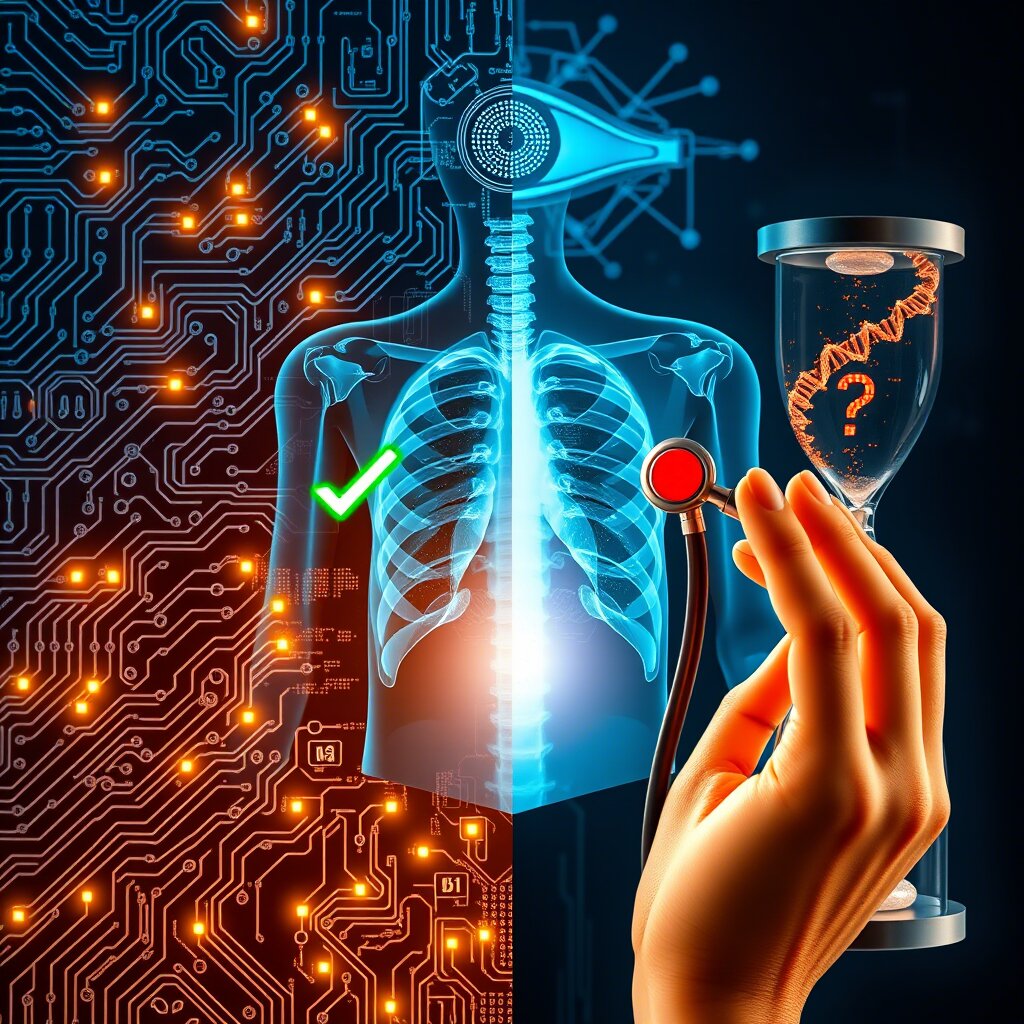
The integration of artificial intelligence (AI) into medical diagnosis is revolutionizing healthcare, offering unprecedented accuracy in detecting diseases like cancer, diabetes, and heart conditions. However, as algorithms outperform humans in some tasks, critical questions arise: Can machines replace doctors? Or do they simply empower them? This article explores the dual narrative of AI’s groundbreaking potential and the ethical, practical, and psychological challenges of relying on “black-box” technology.
The Rise of AI in Medical Imaging
AI systems, trained on millions of medical images, now detect anomalies with superhuman precision. For example:
-
A 2023 Nature Medicine study showed AI algorithms identifying breast cancer in mammograms 30% faster than radiologists, with 98% accuracy.
-
Google’s DeepMind AI can diagnose 50+ eye diseases from retinal scans, matching world-class ophthalmologists.
These tools reduce diagnostic errors—a leading cause of medical malpractice—and enable early intervention. Yet, their success hinges on diverse, unbiased datasets. A flawed algorithm trained on skewed data (e.g., underrepresenting ethnic minorities) risks misdiagnosing millions.
Beyond Speed: How AI Enhances Human Decision-Making
AI doesn’t just automate tasks—it augments human expertise. Platforms like IBM Watson analyze patient histories, genetic data, and global research to suggest tailored treatments. In rural areas with limited specialists, AI-powered apps like Ada Health provide preliminary diagnoses, bridging healthcare gaps.
However, over-reliance on AI poses risks. A 2022 Harvard study found that doctors who blindly followed AI recommendations ignored their own clinical judgment, leading to errors in 15% of cases. Trust must be earned, not assumed.
Challenges: Bias, Ethics, and the "Human Touch"
-
Data Bias: If an AI model is trained mostly on Caucasian patients, it may fail to diagnose skin cancer in darker skin tones. Fixing this requires inclusive data collection.
-
Transparency: Most AI systems operate as “black boxes.” Doctors—and patients—deserve explanations for AI-driven diagnoses.
-
Job Displacement Fears: While AI handles repetitive tasks, it cannot replicate empathy or complex patient communication. The future lies in collaboration, not competition.
The Path Forward: Collaboration, Not Replacement
Regulatory bodies like the FDA are now certifying AI tools with rigorous standards. Meanwhile, hospitals are training staff to “partner” with AI—using it as a second opinion rather than a final authority. For instance, at Mayo Clinic, radiologists review AI-flagged scans, combining algorithmic speed with human intuition.
Conclusion
AI in medical diagnosis is a double-edged sword: a tool of remarkable precision that demands careful governance. While it can transform healthcare accessibility and accuracy, its success depends on addressing biases, ensuring transparency, and preserving the irreplaceable human connection in medicine. As Dr. Eric Topol, author of Deep Medicine, asserts: “AI’s greatest role isn’t to replace us—it’s to give doctors the gift of time to be more human.”